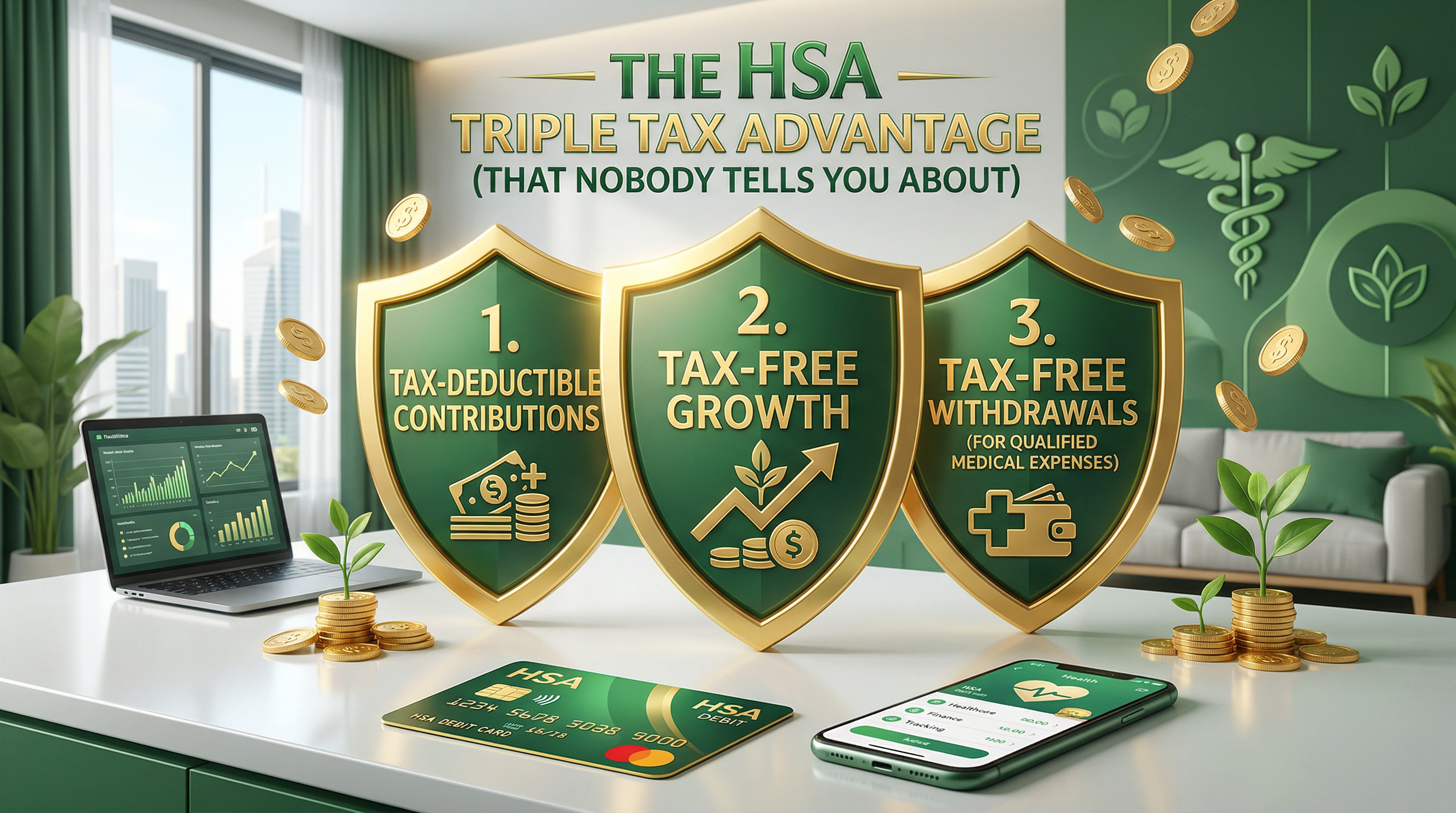
For three years I had access to an HSA through my employer and contributed exactly $0 to it. I thought HSAs were just slightly better savings accounts for medical bills — not especially interesting for someone focused on wealth building. I was wrong in the most expensive way possible. The HSA is, according to nearly every financial planner, the single most tax-advantaged account available in the US tax code. And almost nobody under 30 is using it properly.
What Is an HSA?
A Health Savings Account (HSA) is a tax-advantaged account available to people enrolled in a High-Deductible Health Plan (HDHP). In 2026, the contribution limits are $4,150 for individuals and $8,300 for families. But what makes the HSA different from any other savings or investment account is something that doesn't exist anywhere else in US tax law: the triple tax advantage.
The Triple Tax Advantage Explained
- Tax-Free Contributions: Money you put into an HSA is contributed pre-tax (if through payroll) or is deductible from your taxable income (if contributing directly). Every dollar you put in reduces your taxable income by $1.
- Tax-Free Growth: HSA funds invested in stocks, ETFs, or mutual funds grow completely tax-free. No capital gains tax, no dividend tax — the account grows like a Roth IRA.
- Tax-Free Withdrawals: Withdrawals used for qualified medical expenses are 100% tax-free, both on the contributions and the growth. No other account offers this.
A Roth IRA has two of these advantages (tax-free growth + withdrawals). A Traditional IRA has one (tax-free contributions). The HSA is the only account with all three.
The "Stealth IRA" Strategy: How to Use Your HSA for Retirement
The triple tax advantage is already incredible. The HSA's hidden superpower for wealth builders is its retirement conversion at age 65.
After age 65, you can withdraw HSA funds for ANY reason — not just medical expenses — without penalty. You simply pay ordinary income tax, exactly like a Traditional IRA. This means an HSA functions identically to a Traditional IRA after 65, with the additional option to withdraw tax-free for medical expenses (which in retirement are typically significant).
The Investment Strategy: Pay Medical Bills Out of Pocket Now
Here's the advanced move: instead of reimbursing yourself from your HSA for current medical expenses, pay those bills from your regular checking account and let your HSA investments compound tax-free. Keep all your medical receipts. Years later — potentially decades later — you can reimburse yourself for all those old expenses, effectively creating a tax-free withdrawal for any purpose.
There is no time limit on reimbursing yourself for past qualified medical expenses. A medical bill from 2026 can be reimbursed from your HSA in 2046 — with 20 years of tax-free growth in between.
The HSA requires an HDHP (High-Deductible Health Plan) to contribute. For young, healthy people with low expected medical needs, HDHPs often make financial sense regardless of the HSA advantage — lower monthly premiums offset the higher deductible for people who don't use much healthcare. Do the math for your specific situation: compare total annual cost (premiums + expected medical expenses) for HDHP vs. traditional plan.
2026 HSA Contribution Limits and Numbers That Matter
- 2026 individual limit: $4,150/year ($345.83/month)
- 2026 family limit: $8,300/year ($691.67/month)
- Catch-up contributions (55+): Additional $1,000/year
- Average healthcare cost in retirement: $165,000–$315,000 for a couple (Fidelity 2026 estimate)
That last number puts the HSA's value in perspective. If you max your HSA every year from 25 to 65 and invest it at 7% average return, you'd accumulate approximately $907,000 — more than enough to cover retirement healthcare costs tax-free, with significant remaining balance for other purposes.
How to Invest Your HSA
Most employer-provided HSAs have an investment option — but it's not always turned on by default. Log into your HSA portal and look for "invest my HSA" or "investment options." Once activated, you can allocate your balance to mutual funds or ETFs offered by your HSA custodian.
For your HSA investments, follow the same principles as your other long-term accounts: low-cost index funds. The S&P 500 index fund equivalent from your HSA's investment menu is usually the right core holding. Many HSAs offer Vanguard or Fidelity index funds.
For your taxable brokerage investing alongside your HSA, Traderise gives you access to fractional shares of the same index ETFs with no minimums, making it easy to invest consistently across multiple accounts.
Max Every Tax Advantage Available to You
HSA maxed? Now invest the rest. Traderise makes building your taxable investment portfolio simple — fractional shares, zero minimums, one platform for all your investing needs.
Start Investing FreeHSA vs. FSA: A Quick Comparison
You may also have access to a Flexible Spending Account (FSA) through your employer. Key differences:
- FSA: Use it or lose it (up to $640 rollover per year). Lower limits. Can't invest it. Works with any health plan.
- HSA: Rolls over indefinitely. Can invest for long-term growth. Requires HDHP. The clear winner for wealth building.
If you have both options: choose the HSA if you're healthy and can afford your HDHP's deductible.
The 40-Year HSA Millionaire Math
Max HSA contributions from age 25 to 65:
- Total contributed: $4,150/year × 40 years = $166,000
- Invested at 7% average annual return over 40 years: approximately $877,000
- All withdrawals for medical expenses: tax-free. All withdrawals for non-medical after 65: ordinary income tax (same as Traditional IRA)
Nearly a million dollars in tax-advantaged wealth — accessible for your most expensive retirement cost category (healthcare) with zero tax impact. This is why financial planners consistently call the HSA the most underutilized wealth-building tool in the American tax code.
Your Triple Tax Advantage Is Waiting
Start your HSA strategy today and invest the rest of your portfolio with Traderise — fractional shares of any stock or ETF, no minimums, built for long-term investors.
Try Traderise Free