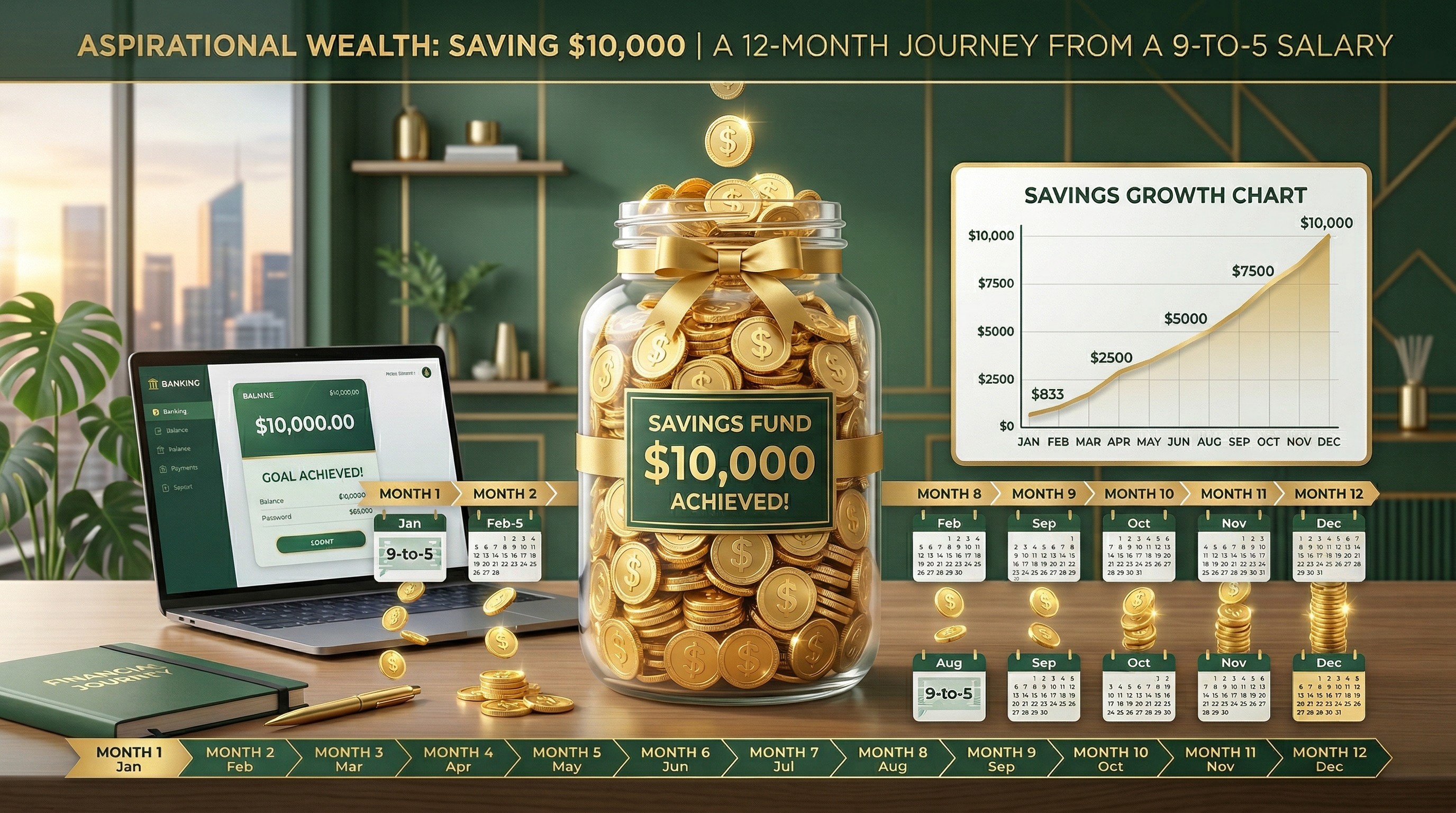
At the start of 2024, I set a goal that felt impossible: save $10,000 in 12 months. I was making $38,000 a year at an office job, living in a mid-size city, paying $750/month in rent with a roommate. I had $2,200 in my savings account and zero investing experience. My friends told me $10K in a year wasn't realistic on my salary.
By December 31, 2024, I had $10,847. Here's every strategy I used, the exact months they paid off, and the numbers behind them. No side hustle magic. No dramatic lifestyle sacrifice. Just a system.
Why $10,000 in a Year Is More Achievable Than You Think
$10,000 over 12 months breaks down to $833/month — or about $192/week. On a $38,000 salary with $2,600/month take-home, that's 32% of income. Aggressive, yes. Impossible? Absolutely not — especially if you combine multiple strategies instead of trying to slash your way there from one angle.
In 2026, the average Gen Z earner between 22 and 27 takes home between $2,400 and $3,200/month. That means $10K in a year is achievable at nearly every income level in that range if you're intentional.
The 3-Pillar Approach to Saving $10K
Instead of treating this as a single savings goal, I broke it into three pillars:
- Expense Reduction: Find existing money that's leaking out of your budget
- Income Optimization: Squeeze more out of your primary job or add small income streams
- Windfalls & Automation: Capture unexpected money and make saving effortless
Pillar 1: Expense Reduction — Finding $300–$500/Month
The Big 3 Expense Categories (Where 80% of Savings Live)
Housing, food, and transportation account for roughly 70–75% of the average person's budget. If you're not cutting here, you're nibbling at the margins. My $10K year required real decisions in all three.
Housing: I already had a roommate, which saved me ~$400/month vs living alone. If you're in a one-bedroom solo, getting a roommate or moving to a cheaper area is the single highest-leverage action available to most people. Even shaving $150/month off rent saves $1,800 over the year.
Food: I was spending $520/month on food (groceries + dining). I meal-prepped Sundays, cut dining out from 10 times/month to 3, and brought lunch to work every day instead of buying. New total: $260/month. Saved: $260/month = $3,120/year. This single change funded nearly a third of my $10K goal.
Transportation: I drove to work when I could have taken the bus ($2.75/ride vs $4.50 in parking + gas/wear). Switching to transit for 3 of my 5 workdays saved about $90/month after factoring in convenience days I still drove.
Track your spending for just 30 days before you start cutting. Most people have 3–5 categories where they're spending 20–40% more than they realize. The goal isn't to feel guilty — it's to find the "invisible leaks" that are quietly draining your savings potential.
Subscription Audit: Finding $800/Year in 30 Minutes
I used a spreadsheet to list every recurring charge hitting my accounts. Found: 11 subscriptions totaling $127/month. After ruthless evaluation, I kept 4 (total: $40/month) and canceled 7. Annual savings: $1,044. That's over $1,000 recovered in one 30-minute audit.
Pillar 2: Income Optimization — Adding $200–$500/Month
Negotiate Your Salary First
Most people skip the most powerful income lever: asking for more at their current job. In April 2024, I asked for a $3,000 annual raise with market data as backup. I got $2,400. That's $200/month more — $2,400 toward my $10K goal without doing anything additional.
Weekend Side Hustle Sprint
For 4 months (May–August), I did weekend marketplace deliveries for approximately 6 hours per weekend. Average net income: $280/month. Total from side hustle: $1,120. I stopped after August to enjoy the fall without the extra work — and I'd already hit my sub-goals ahead of schedule.
Once You Hit $10K, Put It to Work
Saving $10,000 is the launchpad. Investing it is how you build real wealth. Traderise makes starting simple — fractional shares, no minimums.
Start Investing FreePillar 3: Windfalls & Automation
Tax Refund Strategy
I adjusted my W-4 to avoid a massive refund (giving the government a free loan) but still landed a $1,100 refund in February. Rule: 100% of tax refund goes to the savings goal. That alone covered 11% of my $10,000 target.
The Automatic Transfer System
Every payday (biweekly), I had these automatic transfers fire before I could touch the money:
- $250 → High-yield savings account (emergency fund)
- $150 → Savings goal account (labeled "$10K by December")
- $50 → Investment account on Traderise (building the investing habit in parallel)
Total auto-saved per paycheck: $450. Over 24 paychecks: $10,800. The rest of my strategies were just margin improvement on top of this foundation.
Sell What You Don't Use
Over the year I sold old electronics, furniture I didn't need, books, clothes, and sports gear I'd never used. Total from selling: $890. Facebook Marketplace, Mercari, and eBay handled all of it in maybe 8 hours of work total spread over the year.
Month-by-Month Breakdown: How the $10,847 Came Together
- January: $600 (first auto-saves + new habits kicking in)
- February: $1,700 (tax refund $1,100 + $600 from savings)
- March: $700 (sold $350 of old stuff + $350 savings)
- April: $750 ($200 raise kicked in + side hustle starts)
- May–August: $950/month average ($650 savings + $280 side hustle + subscription audit savings kicking in)
- September–November: $700/month (side hustle stopped, but strong habits)
- December: $797 (final push, year-end total: $10,847)
The Psychological Tactics That Kept Me on Track
Visual Progress Tracking
I printed a simple progress bar and taped it to my fridge. Every $500 saved, I colored in a section. Dumb? Maybe. Effective? Absolutely. The visual cue kept the goal top of mind and made small milestones feel worth celebrating.
The "24-Hour Rule" for Impulse Purchases
For any non-essential purchase over $30, I waited 24 hours before buying. About 60% of things I almost bought I didn't actually want after sleeping on it. Conservative estimate: this saved me $150–$200/month in impulse spending over the year.
Accountability Partner
My coworker and I both set savings goals for the year. We shared monthly updates (not exact amounts — just whether we were on track) and kept each other accountable. Social pressure is a powerful tool. Use it.
What I Did With the $10,847
By January 2025, I had my goal. Here's where it went:
- $3,500 → Emergency fund (boosted to 3-month coverage)
- $7,000 → Roth IRA contribution via Traderise (2024 max contribution)
- $347 → Started a brokerage account for additional investing
That $7,000 Roth IRA investment, at historical average 7% returns, will be worth approximately $106,000 by age 65 — from one year of disciplined saving.
Ready to Save $10K and Invest It?
Use Traderise to start investing your savings — fractional shares, beginner-friendly platform, zero minimums. Your $10K deserves to work harder.
Try Traderise Free